Senior Balance Exercises and How to Progress Them Safely
Balance is a skill, not a fixed trait
People often describe balance as something they either have or have lost. It is more accurate to treat it as a skill that responds to practice, in the same way strength responds to lifting. The reason it declines is usually that it stops being practised, not that the capacity has permanently gone.This article is specifically about balance training and how to make it progressively harder without making it dangerous. If you want a complete routine that combines balance with leg strength, the fall prevention routine covers that ground. Read this one when you want to understand why balance work is structured the way it is, and how to know when you are ready for the next step.
Three systems keep you upright
Standing still is not passive. Your nervous system is constantly combining information from three sources and making corrections you never consciously notice.Vision tells you where you are relative to the room. It is the system most people lean on hardest, which is why balance feels dramatically worse in the dark or on uneven ground at night.The vestibular system in the inner ear senses head position and movement. It is why turning your head quickly, or looking up to a high shelf, can feel destabilizing when the other systems are not compensating well.Proprioception is the sense of where your joints are without looking, fed largely by the feet, ankles, and hips. This is the system that tends to fade with inactivity, and the one that responsive training improves most.Good balance training gradually reduces how much you can rely on the strongest system so the others have to contribute. That is the logic behind almost every progression below, and it is why closing your eyes is a genuine step up rather than a gimmick.
Test where you actually are
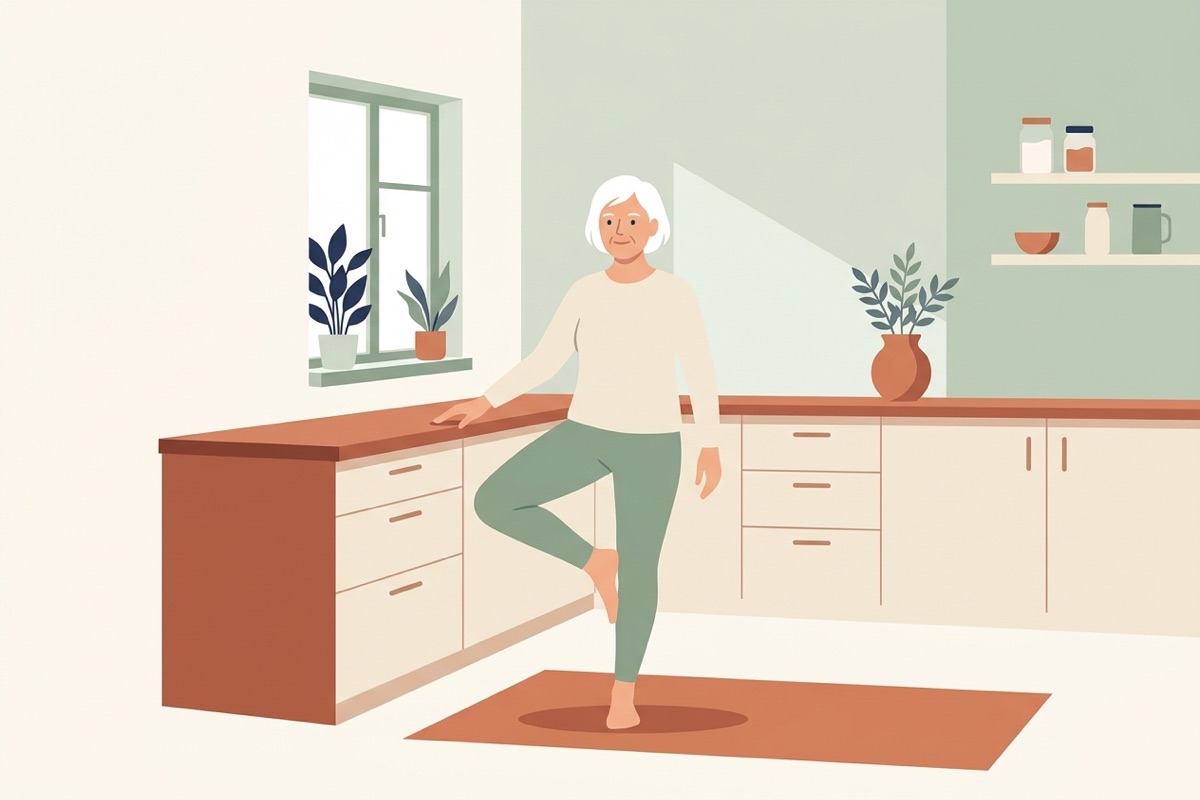
Before progressing anything, get an honest starting point. Stand beside a counter with support within reach, and time how long you can hold a single-leg stand with good posture on each side. Stop the clock when you touch down, grab support, or start visibly swaying.Do the same with your feet in a heel-to-toe line, and again with feet together. Note the numbers and whether one side is clearly weaker than the other. A meaningful side-to-side difference is worth mentioning to a physiotherapist or trainer, since it often points to something specific rather than general decline.Retest every four to six weeks rather than every session. Balance fluctuates day to day with sleep, medication, footwear, and fatigue, so a single bad attempt means very little. The trend over a month is the useful signal.
The progression ladder
Work through these in order. Move up only when you can hold the current step comfortably for 30 seconds on both sides, with light or no hand support, and without holding your breath.Step 1: narrow the base. Stand with feet hip-width, then together, then in a partial heel-to-toe line, then a full heel-to-toe line. Each version gives you less side-to-side margin.Step 2: reduce the support. Go from two hands on the counter, to one hand, to two fingertips, to one fingertip, to hovering your hand just above the surface. That last version is deceptively valuable because the safety net is still there.Step 3: take away vision. Repeat an earlier step with your eyes closed, and expect it to feel dramatically harder. Always do this with a hand on support and a stable surface underfoot. This is where the other two systems are forced to work.Step 4: add head movement. Hold your position while slowly turning your head side to side, then nodding up and down. This challenges the vestibular contribution and mirrors real situations like checking traffic or reaching for a high cupboard.Step 5: add a task. Hold your balance while catching a light ball, passing an object between hands, or simply holding a conversation. Real falls rarely happen while you are concentrating on standing still. They happen while you are doing something else.
What to skip, and why
Wobble boards, foam pads, and unstable surfaces appear in a lot of balance content. They have a place in specific rehabilitation settings under supervision, but they are a poor early choice for most people training at home. They increase risk considerably while adding little that the progressions above do not already provide.Similarly, be cautious with anything that has you balancing at height, on a narrow raised surface, or without a clear support option within arm's reach. The goal is to practise recovering small errors, not to create large ones.Strength is the other half of this. Balance training teaches you to detect and correct a sway, but you need enough leg strength to act on the correction. That is why balance work pairs naturally with resistance training rather than replacing it.
How often, and when to get help
Balance responds to frequency more than duration. Five to 10 minutes on most days will outperform a single long session each week. Attaching it to an existing habit works well: while the kettle boils, while brushing your teeth, while waiting for the microwave.See a professional first if you have had a fall in the past year, experience dizziness or light-headedness, have had a recent medication change, notice numbness in your feet, or have a diagnosed condition affecting balance. Inner ear conditions in particular respond to specific treatment rather than general practice, and no amount of single-leg standing will address them.At Fittopia, balance work can sit alongside coached strength training and physiotherapy in one place, which matters when the right answer is some combination of the three rather than any one of them. Progress here is quiet but real: turning without reaching for the wall, stepping off a curb without thinking about it, standing on one leg long enough to get a sock on.
More Articles
Ready to train?
Start Your Journey at Fittopia
Whether you are brand new to fitness or looking to level up, Fittopia has the coaches, equipment, and environment to get you there.
Talk to a trainer about balance →