Fall Prevention Exercises for Stronger Daily Movement
Why fall prevention training works
A missed curb near Richmond Centre, a slippery entryway after rain, or a quick turn to answer the door can challenge balance more than people expect. Fall prevention exercises prepare your body for these ordinary moments by improving leg strength, steadiness, coordination, and the confidence to keep moving independently.Falls are not simply a senior issue, and they are not an inevitable part of ageing. They become more likely when strength, balance, vision, reaction time, medication changes, pain, or an inactive routine begin to affect how the body responds. The right training can address many of the physical factors within your control, without punishing workouts or complicated equipment.Balance is an active skill. Every step requires your feet, ankles, hips, core, vision, and nervous system to make small adjustments. If the muscles around your ankles and hips are weak, or if you rarely practise shifting your weight, a small trip becomes harder to recover from.Effective training builds three qualities together: lower body strength to rise, climb, and catch yourself; balance to control your centre of gravity; and mobility to take a safe, natural stride. Walking is valuable for general health, but it does not fully train all three. A purposeful routine gives the body a wider range of options when the ground, stairs, or pace changes unexpectedly.
Set up before you start
Begin near a stable kitchen counter, railing, or sturdy chair. Wear supportive shoes, clear loose rugs and clutter from your training space, and keep your phone nearby if you are exercising alone.Use support at first. Letting go before you are ready is not a sign of progress. Controlled, confident movement is. Consistency matters more than intensity here: two or three short sessions per week can create meaningful change when the exercises are performed well and made gradually more challenging.
Sit-to-stands for practical leg strength
Sit near the front of a firm chair with both feet flat and about hip width apart. Lean your chest slightly forward, press through your feet, and stand tall without pulling on the chair or using your hands if possible. Lower slowly until you are seated again.This movement trains the strength needed to rise from a chair, get off the toilet, step out of a vehicle, and recover after a small loss of balance. Start with one or two sets of six to 10 repetitions. If standing without your hands is too difficult, use your hands lightly at first or choose a slightly higher chair. If it becomes easy, slow the lowering phase, hold a light weight close to your chest, or progress to a lower seat under professional guidance.
Heel raises for ankle control
Stand tall behind a counter and hold it lightly with both hands. Lift both heels, pause at the top, then lower them with control. Avoid rushing or leaning your body forward.Your calf and ankle muscles play a major role in correcting small forward and backward shifts. Complete eight to 15 repetitions, pausing briefly at the top. When that feels steady, try using less hand support or lift one heel at a time. The goal is not to balance precariously. The goal is to strengthen the ankles while maintaining clean posture.
Supported single-leg balance for steadiness
Stand beside a counter with one or both hands ready for support. Shift your weight into one foot, then lift the other foot just off the floor. Keep your standing knee soft and your hips level. Hold for 10 to 20 seconds, then switch sides.This closely reflects the single leg control required when walking, stepping around a puddle, or putting on pants. Start with fingertips on the counter. Progress by reducing support, not by closing your eyes or standing on unstable surfaces. Those advanced variations may suit some people, but they are not necessary for a strong foundation.
Tandem walking for coordination
Walk along a clear counter or hallway, placing the heel of one foot close to the toes of the other. Take slow, deliberate steps and keep a hand near support as needed. Look ahead rather than down at your feet.Tandem walking challenges side to side control and coordination. Take eight to 12 steps, turn carefully, and repeat. If heel to toe placement feels too narrow, leave a small gap between your feet. A wider line with excellent control is more useful than a narrow line completed with wobbly, rushed steps.
Side leg lifts for hip strength
Stand upright behind a chair or counter. Shift your weight into one leg and slowly lift the other leg out to the side without leaning your torso. Keep your toes facing forward, then return with control. Repeat eight to 12 times per side.The muscles on the outside of the hip help keep your pelvis stable when you walk or step sideways. Weakness here can make a quick lateral correction harder, especially on uneven pavement or a crowded transit platform. Add a light resistance band only when you can keep your torso still and your movement smooth.
Step-ups for stairs and curbs
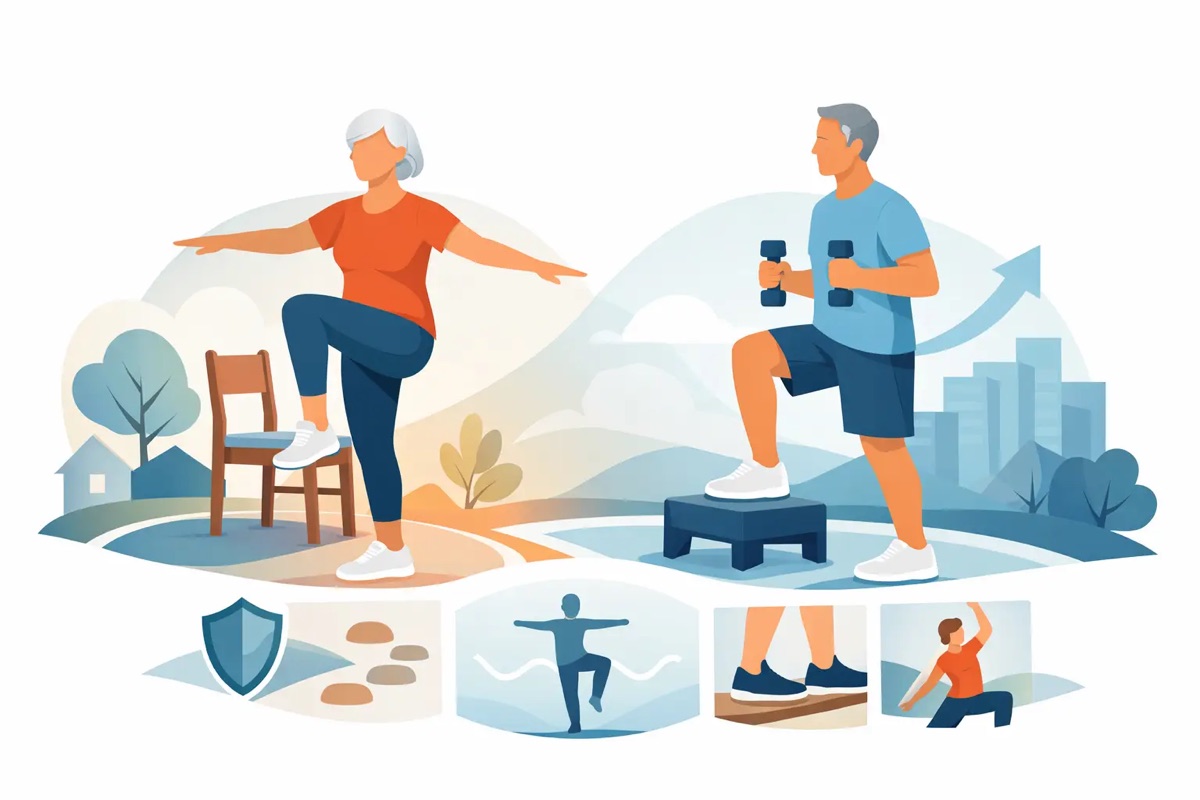
Use the bottom step of a staircase or a low, secure platform with a rail nearby. Step up with one foot, bring the other foot up, then step down slowly. Complete six to 10 repetitions before changing the leading leg.Step-ups develop the strength and control needed for curbs, stairs, and bus steps. Keep the step low enough that you can avoid pushing heavily through the rail or twisting your knee. Knee, hip, or back pain during the movement is a reason to stop and seek individual advice rather than forcing the exercise.
Build a routine you will actually keep
For most adults, a 15 to 20 minute routine is enough to begin. After a brief warm up of easy marching, shoulder rolls, and ankle circles, choose three or four exercises and complete one or two sets. Include both strength work, such as sit-to-stands and step-ups, and balance work, such as single leg stands and tandem walking.Train on non-consecutive days where possible. Muscles need recovery, while balance benefits from frequent practice. Some people prefer a focused session three times weekly. Others get better results by adding one balance exercise while waiting for the kettle, or doing heel raises while brushing their teeth. Either approach works when it is safe and repeated.Progress one variable at a time. You might add two repetitions, reduce hand support slightly, slow the lowering portion, or improve the quality of each hold. Do not change everything in the same week. A program that feels manageable is far more likely to become a lasting habit than one that leaves you sore, nervous, or discouraged.
When to get professional support
Exercise should challenge you, not make you feel unsafe. Speak with a physician, physiotherapist, or qualified exercise professional before beginning if you have had a recent fall, frequent dizziness, fainting, unexplained numbness, severe joint pain, or a condition that affects balance. A medication review can also matter, particularly if you notice new light-headedness after a prescription change.Individual coaching is especially useful when pain, a past injury, osteoporosis, stroke recovery, or significant arthritis changes how you move. The best plan may include modified strength exercises, mobility work, gait practice, or supervised reformer Pilates. There is no prize for following a generic routine when your body needs a more tailored starting point.At Fittopia, certified training, mobility support, reformer Pilates, and physiotherapy sit on one practical path, whether your goal is returning to confident walks, managing pain, or staying active for the people and places you enjoy.Small improvements add up quickly: standing from a chair with less effort, taking stairs with more control, turning without grabbing for a wall. Practise these movements with patience, use support when you need it, and let stronger daily movement become part of how you protect your independence.
More Articles
Ready to train?
Start Your Journey at Fittopia
Whether you are brand new to fitness or looking to level up, Fittopia has the coaches, equipment, and environment to get you there.
Talk to a trainer about a balance plan →