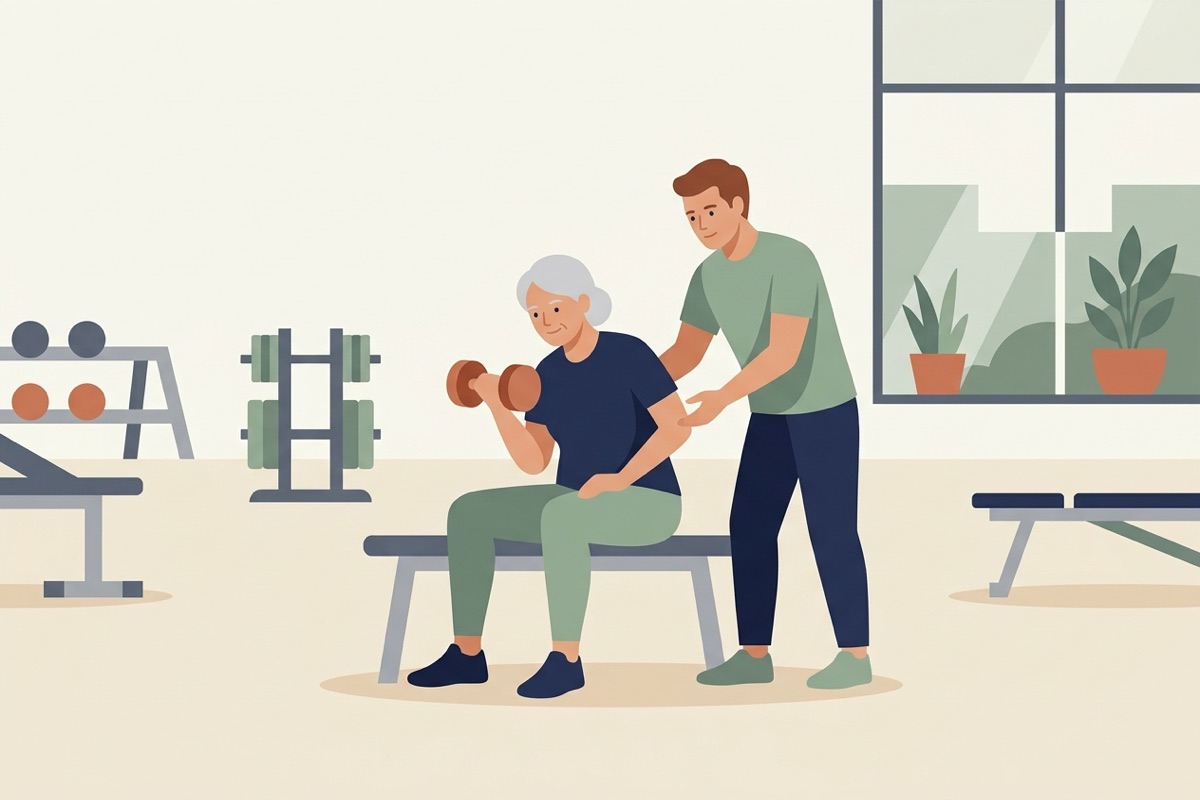
Can Seniors Lift Weights? Yes, and Here Is How to Start
The short answer
Yes. Resistance training is not only safe for most older adults, it is one of the few interventions that addresses several age-related problems at once: loss of muscle, loss of bone density, declining balance, and reduced independence in daily tasks.The question usually comes loaded with a second, unspoken one: is it safe for me specifically, at my age, with my knees, my blood pressure, my history. That is a better question, and the answer is usually still yes with the right starting point and, where relevant, a conversation with your physician first.The risk people worry about is injury from lifting. The risk that is far more common in practice is the slow loss of strength from not lifting, which arrives quietly and eventually shows up as difficulty rising from a chair, carrying groceries, or recovering from a stumble.
What strength training actually does after 60
Muscle mass and, more importantly, muscle power decline with age unless they are trained. Power, the ability to produce force quickly, fades faster than raw strength and matters enormously for catching yourself when you trip.Resistance training also loads bone, and loaded bone is stimulated to maintain density. This is one of the reasons weight-bearing exercise is commonly recommended alongside medical management for bone health, though anyone with diagnosed osteoporosis should get exercise guidance specific to their situation rather than following general advice.The practical benefits show up in ordinary tasks. Stronger legs make stairs and chairs easier. A stronger grip makes carrying and opening things easier. A stronger trunk makes getting out of bed and off the floor easier. These are the things that determine whether someone stays independent, and they respond well to training at any age.
Get clearance when these apply
Most people can begin a sensible resistance program without medical clearance. Speak with your physician first if you have uncontrolled high blood pressure, a heart condition or recent cardiac event, diagnosed osteoporosis, a recent surgery or joint replacement, uncontrolled diabetes, active dizziness or fainting, a hernia, or eye conditions such as advanced glaucoma or a recent retinal issue.This is not a list of reasons to avoid training. Nearly all of these are reasons to train with specific modifications rather than not at all. What clearance gives you is knowledge of which modifications matter for you, which is far more useful than a blanket instruction to be careful.If pain or a past injury is part of the picture, an assessment with a physiotherapist before you start is time well spent. It converts a vague worry into a specific plan.
What to start with
Begin with machines and supported movements rather than free weights. This is not a lesser version of training. Machines control the path of the movement, which lowers the coordination demand and lets you focus on producing force safely while you learn.A sound first program covers six patterns: a leg press or supported squat, a seated row, a chest press, a hip hinge variation appropriate to your back, a loaded carry, and a calf or ankle exercise. Two sessions per week, one or two sets each, is a genuine starting dose.Choose a load you could lift roughly twice more than you actually do. Finishing a set feeling like you had a bit left is correct at the start, not a wasted effort. Training to complete failure offers little benefit here and adds meaningful risk.Breathe throughout. Holding your breath under load raises blood pressure sharply, which is the single most relevant safety point for older adults with cardiovascular considerations. Exhale on the effort, and if you cannot maintain breathing, the load is too heavy.
Progress deliberately
Muscle adapts at any age, though recovery generally takes longer than it did at 30. Leave at least a day between sessions that train the same movements, and treat sleep as part of the program rather than separate from it.Add load in small increments, and add it after you can complete your target repetitions with clean technique on two consecutive sessions. Adding a repetition, adding a set, or slowing the lowering phase are all legitimate progressions that do not require touching the weight at all.Expect some muscle soreness in the first two weeks, particularly one to two days after a session. That is normal. Sharp pain during a movement, joint pain that worsens set to set, chest discomfort, dizziness, or unusual shortness of breath are not, and warrant stopping and seeking advice.Pair strength work with balance training. Strength gives you the capacity to correct a stumble; balance training is what detects the stumble early enough to use it. Neither substitutes for the other.
What to ignore
Ignore the idea that older adults should only use light weights and high repetitions. Very light loads that never challenge you produce very little adaptation. The load should be appropriate and progressive, which for many people means heavier than they expect after a few months.Ignore the idea that it is too late. Meaningful strength gains have been demonstrated in people well into their eighties and nineties. Starting later means starting from a different point, not being excluded.And ignore anyone who treats your age as a reason not to coach you properly. A good trainer will ask about your history, watch how you move, adjust exercises to fit you, and progress you like they would anyone else. If you want to see how that works before committing, a complimentary intro session is the simplest way to start, and coached senior strength sessions are an alternative if you would rather begin in a group.
More Articles
Ready to train?
Start Your Journey at Fittopia
Whether you are brand new to fitness or looking to level up, Fittopia has the coaches, equipment, and environment to get you there.
Book your free intro session →