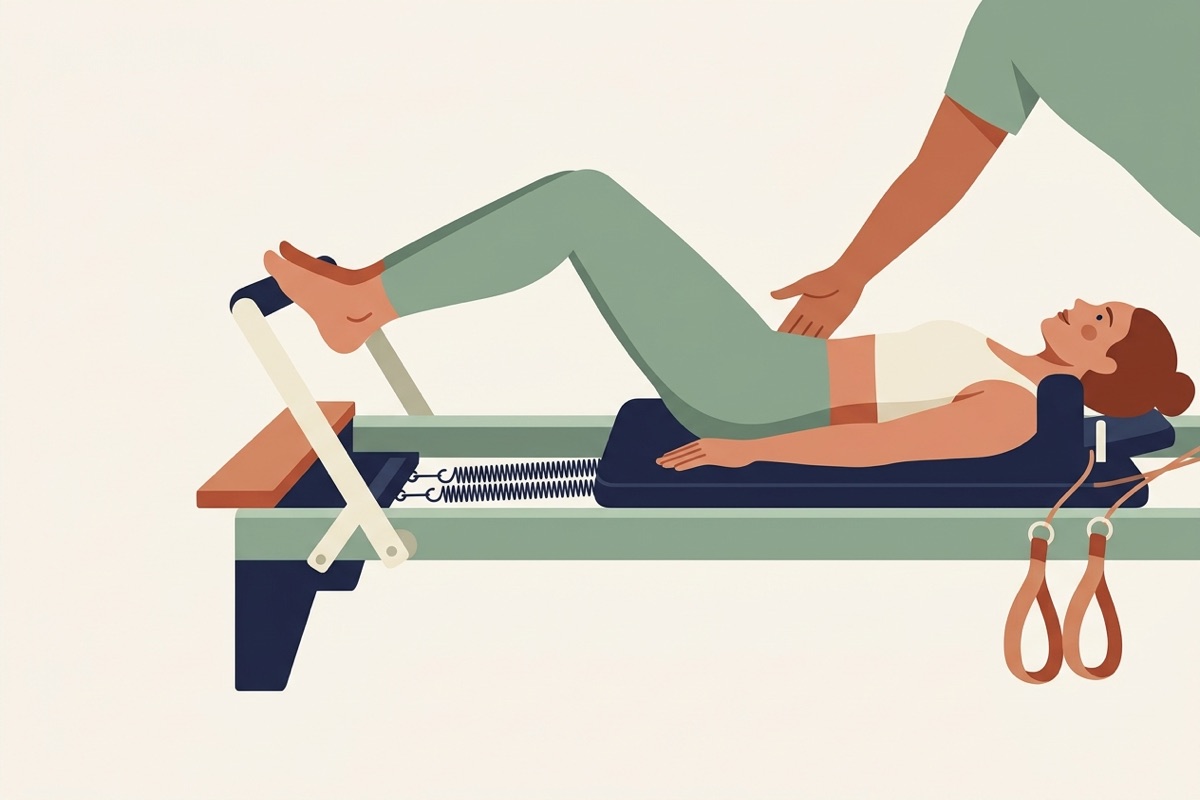
Reformer Pilates Technique: What Good Actually Looks Like
Technique is what separates two identical-looking reps
Two people can perform the same reformer exercise, move the carriage the same distance, and finish the same number of repetitions, while getting very different results. One is building control through the hips and trunk. The other is moving the carriage with momentum and letting the springs do the organizing.This guide is about the second layer of reformer Pilates: not which exercises to do or whether the format suits you, but what good execution feels like once you are on the machine. If you are still deciding between formats, start with reformer versus mat. If you have never taken a class, the beginners guide covers what a first session looks like.The reformer is unusually honest equipment. Because the carriage only moves when you move it, and because the springs return energy, sloppy technique shows up immediately as a jerk, a slam, or a shake. Learning to read that feedback is most of the skill.
Setup decides the rep before you start moving
Most technique problems are setup problems. Before the first repetition, three things should be settled: where your body sits on the carriage, where your hands or feet are placed, and which spring load you are working against.Position first. For footwork, your shoulders should rest against the shoulder blocks without your neck straining to hold your head up. If you are sliding into the blocks on every return, you have started too close. For strap work, arm length matters: you want tension in the strap at the start position, not slack that snaps taut halfway through.Placement second. On the footbar, the difference between the ball of the foot, the arch, and the heel changes which muscles do the work and how the ankle and knee are loaded. None of these is wrong, but they are not interchangeable. Your instructor should tell you which one the exercise is asking for, and why.Spring load last, and this is the one most people get backwards. Lighter is not automatically easier. On many exercises, a lighter spring means less support and more demand on your control. On others, a heavier spring genuinely adds resistance. Ask which kind of exercise you are doing before you reach for the lightest setting.
Control the return, not just the push
If there is one habit that improves reformer technique faster than any other, it is owning the return phase. Pushing the carriage out is the part that feels like work. Letting it come back is where most people give up the tension and let the springs take over.A controlled return means the carriage arrives without a sound. If you hear a click or a knock as it closes, the springs finished the movement for you. Slowing the return is not a cosmetic detail. It roughly doubles the working time of the repetition and it is where a great deal of the strength benefit lives.A useful self-check: try stopping the carriage halfway through the return and holding for two seconds. If you can, you are in control of the load. If the carriage keeps travelling, the spring setting or the tempo needs adjusting.
Breathe with the movement, not against it
Pilates breathing gets described in ways that make it sound mystical. Practically, it does two jobs: it stops you from bracing rigidly through the ribs, and it gives the movement a rhythm so you are not rushing.The general pattern is to exhale on the effort, though a good instructor will sometimes reverse this deliberately to change the challenge. What matters more than the pattern is that you are breathing at all. Holding your breath through a set is a reliable sign the exercise is currently too hard, or that you are gripping somewhere you do not need to.Watch your ribs. If your lower ribs flare upward and forward as you inhale, especially during overhead or strap work, the connection through your trunk is being lost. Softening the ribs down without clenching the abdominals is one of the more useful things you can learn on the machine, and it carries directly into lifting.
The five errors instructors correct most
Gripping the toes. Curling the toes around the footbar usually means the foot is doing the stabilizing that the hip should be doing. Spread the foot, keep the toes long, and let the ankle stay neutral.Shoulders creeping toward the ears. Common in strap work and any pulling exercise. It typically means the load is too high or the range too long for current control. Shorten the range before you add weight back.Hyperextending the knees. Locking out hard at the end of footwork feels like a full range, but it dumps the load into the joint rather than the muscle. Stop just short of full extension and keep tension in the thigh.Letting the pelvis tip on single-leg work. When one leg is loaded, the opposite hip often drops or rotates. This is the exact pattern the exercise is meant to train, so it is worth reducing the range until you can keep the pelvis level rather than pushing through and reinforcing the shift.Chasing range over control. A longer carriage travel looks more impressive and is frequently less useful. Range earned through control transfers. Range borrowed from momentum, joint laxity, or a compensating segment does not.
How to progress without losing quality
Progression on the reformer is not only about heavier springs. You can make an exercise harder by slowing the tempo, adding a pause at the hardest position, lengthening the lever, reducing your base of support, or removing a hand from the frame. Several of these increase difficulty while the spring load goes down.Change one variable at a time and give it two or three sessions before changing another. If technique degrades when you progress, that is information rather than failure. Step back to the previous version, keep it clean for a couple of weeks, then try again.Small classes matter here more than in most formats, because spring settings and body positions are individual. At Fittopia Wellness Studio the AXIS reformers and small group sizes let an instructor actually see your setup and adjust it, which is the part that no video can replace. If you want a session where every correction is yours, private Pilates is the faster route to clean technique.And if a movement consistently produces sharp pain, pinching, or symptoms that persist after class, that is not a technique problem to push through. Stop, tell your instructor, and get it assessed properly.
More Articles
Ready to train?
Start Your Journey at Fittopia
Whether you are brand new to fitness or looking to level up, Fittopia has the coaches, equipment, and environment to get you there.
See the Studio intro offer →