Pilates for Desk Workers Who Want Better Posture
What Better Desk Posture Should Actually Deliver
You round your shoulders over a laptop on the Canada Line, then round them again through a string of back-to-back video calls. By mid-afternoon your neck feels wound tight and your lower back complains before you have even left your chair. Sitting up straighter for five minutes rarely fixes any of that.Posture is not one position you are supposed to hold for eight hours. It is capacity, meaning how easily your upper back extends, how freely your hips open, and how well your trunk manages the small shifts of an ordinary day. When that capacity is missing, no amount of willpower keeps your spine stacked.This is where reformer Pilates can help, and it works less like a posture correction and more like restoring the range you have lost. The goal is a body that moves well through the day, not a pose you hold at your desk.
What Hours at a Desk Actually Do to Your Body
Sitting for long stretches does not damage your spine, but it does encourage your body to adapt to the shape it spends the most time in. Hip flexors shorten because they rarely lengthen, and the thoracic spine, the mid-back region between your shoulder blades, loses some of its ability to extend.Your breathing often follows the same pattern. Shoulders creep toward your ears, the upper chest does most of the work, and the ribs barely move. None of this is an injury. It is simply what stillness does to tissue that is capable of much more.The encouraging part is that this kind of stiffness responds well to consistent movement. It is a habit your body has learned, and habits can be retrained with the right input.None of this means every desk worker ends up in pain, and it is not a countdown to a worse problem down the road. For most people it is simply a pattern of tightness and reduced range that movement can gradually reverse.
How Reformer Work Targets the Real Problem
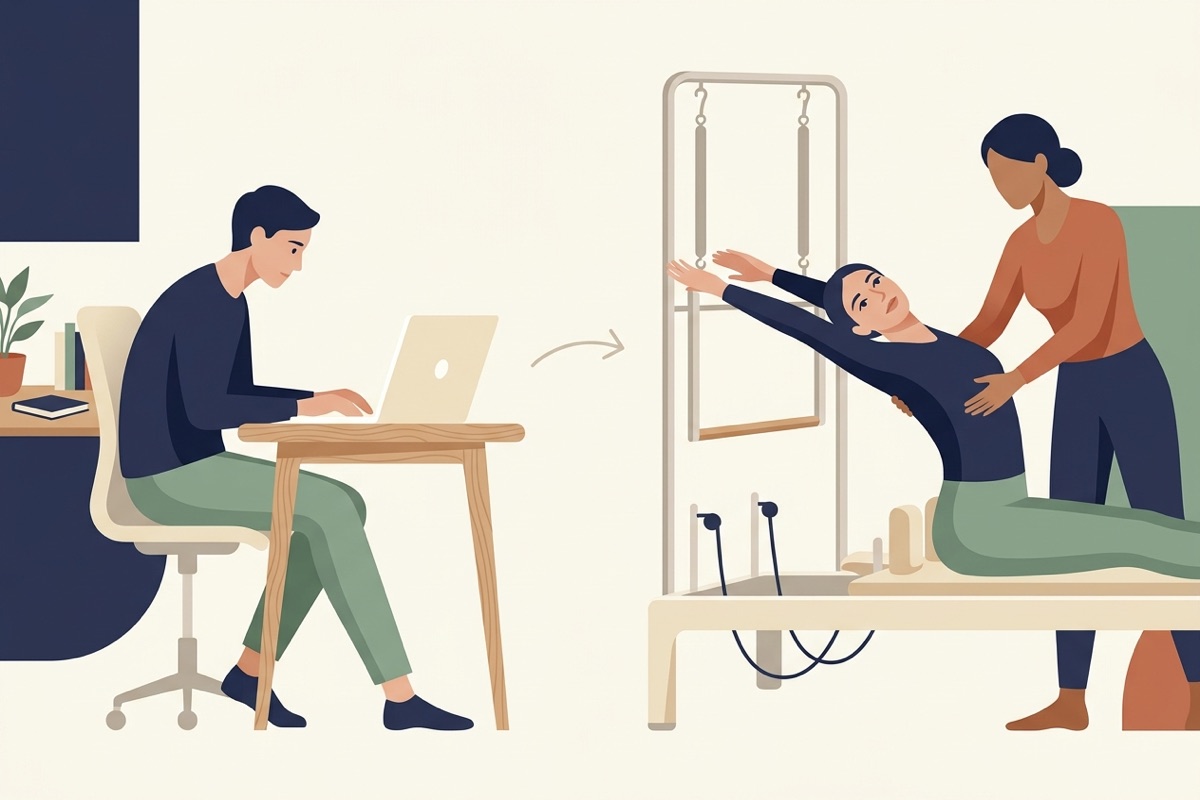
The AXIS reformer uses spring resistance and a sliding carriage to load movement through a controlled range, which makes it well suited to rebuilding thoracic extension. Exercises on the long box and short box ask your upper back to extend against gentle resistance, something a desk chair never asks of you.Hip openers on the reformer work the same way. Footwork and strap-based exercises take your hips through flexion, extension, and rotation with support from the springs, so tight hip flexors get to lengthen gradually instead of all at once.Breathing is trained deliberately too. Instructors often cue breathing into the sides and back of your ribs rather than the chest, which helps restore the trunk control that shallow, desk-bound breathing tends to erode. If you are curious how this differs from a mat class, reformer versus mat Pilates breaks down the springs and support that make the reformer version distinct.
Who This Helps
Beginners often worry Pilates requires existing flexibility or core strength. In practice, the reformer supports your body through the movement, so a first-timer can work at the same time as someone who has trained for years, just with different spring settings. An instructor can also scale range and resistance session to session, so early stiffness is never a reason to sit a class out.Experienced lifters tend to notice reformer work fills a gap that heavy training does not address on its own, particularly thoracic mobility and rotational control. It pairs naturally as cross-training rather than replacing strength work.For people managing pain, especially in the low back, reformer Pilates can be part of a graded return to movement, though it is not a substitute for a diagnosis. Our Pilates for back pain article goes deeper on what that looks like in practice.Older adults tend to benefit from the hip mobility and trunk control work in particular, since both are closely tied to balance and to staying steady on stairs, curbs, and uneven ground.
Your First Session: What to Expect
A first session usually starts with your instructor watching how you move before adding resistance. They are looking for where your spine is stiff, where your hips are tight, and how you breathe under light effort.From there, expect simple footwork on the reformer carriage, some gentle work on extension, and cueing on breathing that may feel unfamiliar at first. Nothing about it should feel rushed or competitive.Most people leave the first class more aware of their own posture than they were walking in, which tends to matter more than any single exercise. That awareness is often what carries over into the rest of the week, long after the class itself has ended.
What a Twice-Weekly Month Realistically Changes
Twice a week for a month is often enough for many people to notice less stiffness by the end of a workday and an easier time reaching overhead or turning to check a blind spot. Full mobility changes usually take longer, and that timeline can vary quite a bit from person to person.At Fittopia, that consistency can include reformer sessions at the Studio alongside personal training and on-site physiotherapy at the Center, so posture work does not sit in isolation from the rest of how you move and train.One honest limitation is worth naming here. Pilates will not undo the effect of an eight-hour day at a poorly set desk, and it does not replace standing up and moving every hour. Think of it as the counterweight to desk time, not a replacement for changing the desk itself.
Red Flags That Mean Assessment First
Ordinary stiffness, a tight upper back, or hips that feel locked after sitting are exactly what reformer Pilates is built to address. Numbness, tingling, or pain that radiates down an arm or leg are different, and they are not something to work through on your own.If you notice those symptoms, an assessment should come before a Pilates class, not after. On-site physiotherapy can help identify what is actually going on, and a Pilates instructor will always defer to that kind of evaluation rather than guess at it.This is not meant to alarm you. Most desk-related tightness is exactly that, tightness, and it responds well to movement. The point is simply knowing which category you are in before you start.
Build the Capacity, Not Just the Posture
Good posture was never going to be a position you hold through willpower alone. It is the result of a body that can extend, open, and stabilize when it needs to, built through consistent, well-targeted movement.Start with an assessment of how you actually move, do reformer work twice a week for a month, and let your desk days feel a little less like something you have to recover from. See the Studio intro offer to book your first session.
More Articles
Ready to train?
Start Your Journey at Fittopia
Whether you are brand new to fitness or looking to level up, Fittopia has the coaches, equipment, and environment to get you there.
See the Studio intro offer →