Free Weights vs Machines for Every Stage
What Free Weights vs Machines Should Actually Deliver
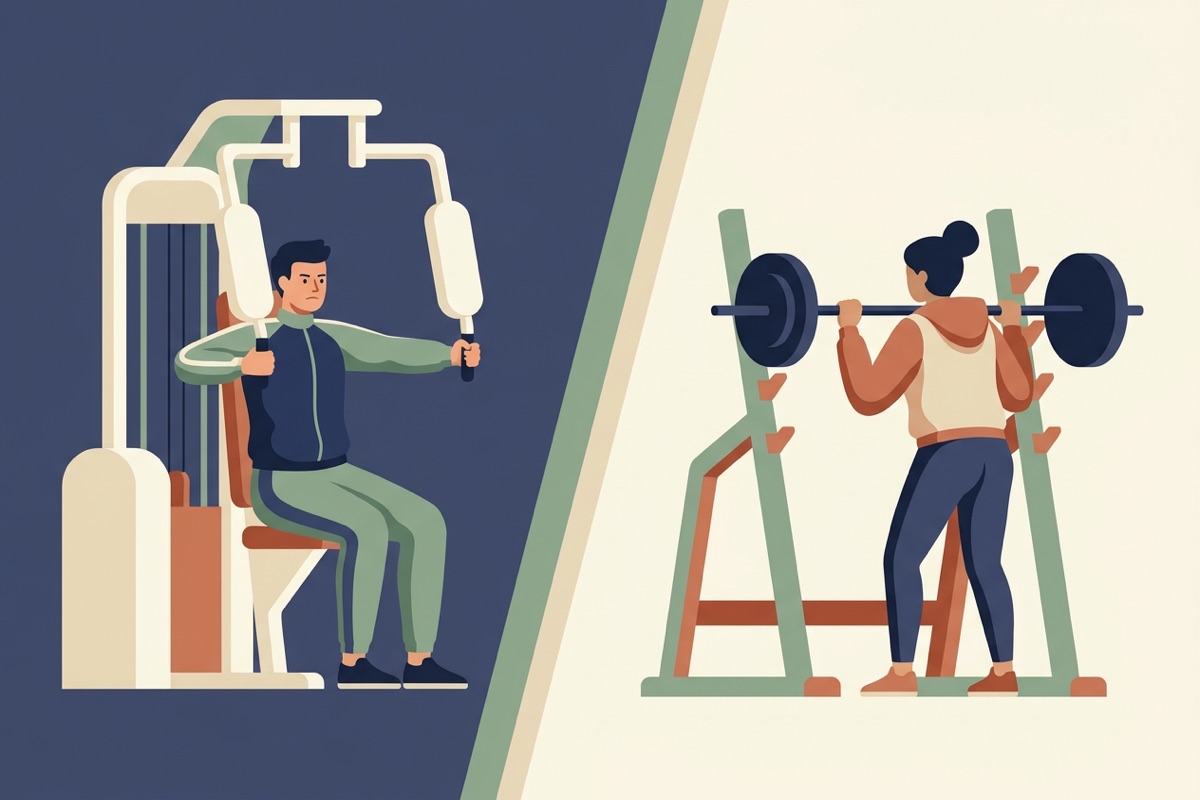
Free weights versus machines is one of the oldest debates in a gym, and it should stay a debate about sequence, not sides. Machines earn their spot first for most new lifters, since a guided path lets you feel how a muscle should work under load before you also manage balance. Free weights earn their spot next, adding the stabilizer demand and real-world carryover that a fixed track cannot replicate. For many people, the honest answer is both, staged in the right order rather than argued over.A good equipment plan should deliver three things: a path you can trust while you are still learning, enough variety to keep you progressing for years, and a way to train safely around whatever your body is dealing with this month. It should also flex as your experience grows. What works for a first visit often looks different by month six, and it can look different again for someone rebuilding strength after an injury or a joint replacement. Judging free weights versus machines as a single verdict misses that the right mix changes as you do.
Why Machines Are a Smart Place to Start
Machines are built to remove the hardest part of lifting for a beginner, which is figuring out the path. A leg press or a chest press moves along a fixed track, so your joints follow a groove that is already set for a safe range of motion. That structure means you can focus on effort and form instead of also managing balance, and a trainer can spot a breakdown in your technique faster because there are fewer variables in play.That predictability often builds confidence fast, and confidence matters more than most beginners expect. Walking into a gym for the first time can feel like everyone else already knows the unwritten rules, and a machine with a clear seat, a clear pin, and a clear range of motion tends to remove that guesswork. You can load a stack, adjust a seat, and start moving without needing anyone to hand you a barbell and hope you know what to do with it. For many first-time members, that first confident set on a machine is what makes the second visit happen.Machines are also excellent at isolating one muscle group at a time, which helps when you are rebuilding strength in a specific area or simply learning what a hamstring curl or a lat pulldown should feel like before you add it to a compound lift. A trainer can use that isolation to correct an imbalance, whether that means a weaker side after months of favoring an injury or a shoulder that has not caught up with the rest of your upper body.
What Free Weights Add Once You Are Ready
Free weights bring back the stabilizer muscles that a fixed track quietly removes from the equation. A dumbbell press or a barbell squat asks your core, your shoulders, and dozens of smaller supporting muscles to help hold the weight on a path you control, not a machine. That extra demand is often exactly what closes the gap between looking strong on a machine and feeling strong carrying groceries or moving furniture into a new place.That carryover is usually called transfer, and it is the main argument experienced lifters make for free weights. A squat pattern trained with a barbell tends to transfer to real movement, sport, and daily tasks more directly than a leg press pattern does, because your body has to organize itself the whole time, not just push against a fixed track.Free weights also offer more room to keep progressing over years of training. You can add small plates in fine increments, change grip width, change stance, or move from dumbbells to a barbell as strength builds, long after a machine's weight stack has topped out for your level. For an experienced lifter, that headroom is often the difference between a program that keeps working and one that quietly plateaus. A well-equipped free-weight area gives that progression somewhere to go.
How the Answer Changes by Person
If you are just starting out, machines are usually the sensible entry point. They let you learn effort, tempo, and range of motion with less to manage at once, and that early win can matter more than a textbook-perfect program. Building basic gym confidence in your first few weeks often matters more than which tool gets you there, and machines tend to shorten that runway.If you already have a training history, free weights should usually carry more of the load, since your body can handle the added coordination demand and you likely need the extra progression headroom to keep results coming. Machines still have a place here too, often for isolation work at the end of a session or for pushing a muscle group past what a compound lift alone can reach.If you are working around an injury or coming back from physiotherapy, the order can flip again. A machine's fixed path can let you load a joint safely while you rebuild range of motion and confidence, without asking a healing shoulder or knee to also stabilize a free weight. This is where scope of practice matters: a trainer can guide general strength work, but pain that is sharp, sudden, or lasting deserves a proper assessment rather than a guess, so loop in a physiotherapist before you push through it.If you are training for strength, balance, and independence later in life, machines often provide a safer way to keep loading your muscles without the fall risk that comes with a loaded barbell overhead or a dumbbell you might drop. Free weights still belong in a senior program, usually in lighter, well-supervised doses that build the grip strength and stabilizer work daily life actually asks for, like carrying bags or catching your balance on a curb.
Your First Session: What to Expect
Whichever category fits you today, you do not have to work out that starting point alone. At Fittopia, that blend can live on one floor: Canada's first fully equipped Arsenal Strength setup sits alongside personal training, Pilates at the Wellness Studio, and on-site physiotherapy, so your equipment choices and your recovery plan can come from the same team.A first session built around this question usually starts with a short conversation about your history, any pain points, and what you are training for, not a fixed list of exercises. Expect a mix: a machine or two to establish a safe baseline, paired with a simple free-weight movement like a goblet squat or a dumbbell row to see how you move under a little instability. A free intro session is usually the easiest way to get that assessment before you commit to anything.From there, a reasonable plan should tell you not just which exercises to do, but why each one is a machine or a free weight on that particular day. That reasoning is often more valuable than the exercise list itself, since it teaches you how to make the same call yourself once the program changes.
A Sensible Blend by Goal
For general health and muscle, a blend that leans on free weights for the big compound patterns and machines for accessory and isolation work tends to cover the most ground. For pure strength goals, free weights should usually dominate, since the skill of moving a real bar is part of the goal itself. For rehab or return-to-activity goals, machines often come first and free weights get reintroduced gradually as range of motion and confidence return.The honest limitation is that no single ratio works for everyone forever. What looks right this year can look different again after an injury, a new goal, or simply a few more years of training. That flexibility is not a flaw; a plan built to be adjusted tends to last longer than one built to be perfect.
Start With a Plan, Not a Side
Stop treating free weights versus machines as a loyalty test and start treating it as a sequence. Start with machines if you are new or rebuilding, add free weights as your control and confidence grow, and let your goal, not a gym floor argument, decide the ratio between them. Get an assessment, build the plan around your body today, and adjust it again next year.
More Articles
Ready to train?
Start Your Journey at Fittopia
Whether you are brand new to fitness or looking to level up, Fittopia has the coaches, equipment, and environment to get you there.
Book your free intro session →